Singapore Primary School Ranking 2026: Top Schools & P1 Demand
There is no official Singapore primary school ranking published by MOE Singapore. For 2026, online rankings can look quite different because each site may use its own method, such as school popularity, past results, programmes, affiliation, or P1 registration demand. A useful way to compare schools is to look at applicants versus available vacancies. If a school has far more applicants than places, parents are likely to face tougher competition and possible balloting during P1 registration. But high demand doesn’t automatically mean a school is better for every child. School location, learning environment, programmes, CCAs, affiliation and your child’s needs still matter when making a school choice.
TL;DR — Singapore Primary School Ranking 2026
For a demand-based Singapore primary school ranking 2026, Princess Elizabeth Primary School has the highest Phase 2C applicants-per-vacancy ratio at 3.98×, followed by Northland Primary School and Nan Hua Primary School. This ranking reflects P1 registration demand, not academic quality. A higher ratio simply shows that more families competed for each available place, so parents should also check location, school programmes, CCAs, affiliation and past balloting before making a school choice.
Demand-Based Ranking — 2026 Phase 2C
| Rank | Primary School | Applicants per Vacancy |
| 1 | Princess Elizabeth Primary School | 3.98× |
| 2 | Northland Primary School | 3.36× |
| 3 | Nan Hua Primary School | 3.00× |
| 4 | Chongfu School | 2.85× |
| 5 | Rosyth School | 2.61× |

Singapore Primary School Ranking 2026
The primary school ranking 2026 below uses P1 registration demand as its main measure. Instead of treating academic results or reputation as a single score, it looks at how many applicants competed for each available place in Phase 2C. This gives parents a clearer view of the top primary schools Singapore families were competing for in 2026.
Top 10 Primary Schools by P1 Demand
Demand-based ranking — 2026 Phase 2C
| Rank | School | Phase | Demand | What Makes It Popular |
| 1 | Princess Elizabeth Primary School | 2C | 3.98× | High P1 demand |
| 2 | Northland Primary School | 2C | 3.36× | Strong competition |
| 3 | Nan Hua Primary School | 2C | 3.00× | High demand |
| 4 | Chongfu School | 2C | 2.85× | Competitive intake |
| 5 | Rosyth School | 2C | 2.61× | Strong parent demand |
| 6 | Angsana Primary School | 2C | 2.57× | High registration demand |
| 7 | St. Hilda’s Primary School | 2C | 2.57× | Competitive P1 intake |
| 8 | Nan Chiau Primary School | 2C | 2.42× | High demand |
| 9 | South View Primary School | 2C | 2.39× | Competitive places |
| 10 | Holy Innocents’ Primary School | 2C | 2.20× | Strong demand |
These are popular primary schools Singapore parents showed strong interest in during the 2026 Phase 2C registration exercise. The figures are based on applicants compared with available vacancies, so they show admission competition rather than a school’s academic standing.
What Does 3.98× Demand Mean?
A 3.98× demand means there were about 3.98 applicants competing for every available vacancy. For example, if a school had 40 places and 159 applicants, the ratio would be 159 ÷ 40 = 3.98×.
So, Princess Elizabeth Primary School ranked first in this demand-based list because it had the highest applicants-per-vacancy ratio among the schools shown. A high ratio can point to a most competitive primary school, but it doesn’t automatically make that school the best fit for every child.
How Is the Singapore Primary School Ranking Calculated?
The demand-based ranking uses a simple calculation: Applicants ÷ available vacancies = demand ratio. For example, if a school receives 159 applicants for 40 P1 vacancies, the calculation is 159 ÷ 40 = 3.98×. A higher applicants-per-vacancy ratio shows stronger school demand and greater admission competition during that registration phase. It doesn’t measure teaching quality, academic results or the school environment.
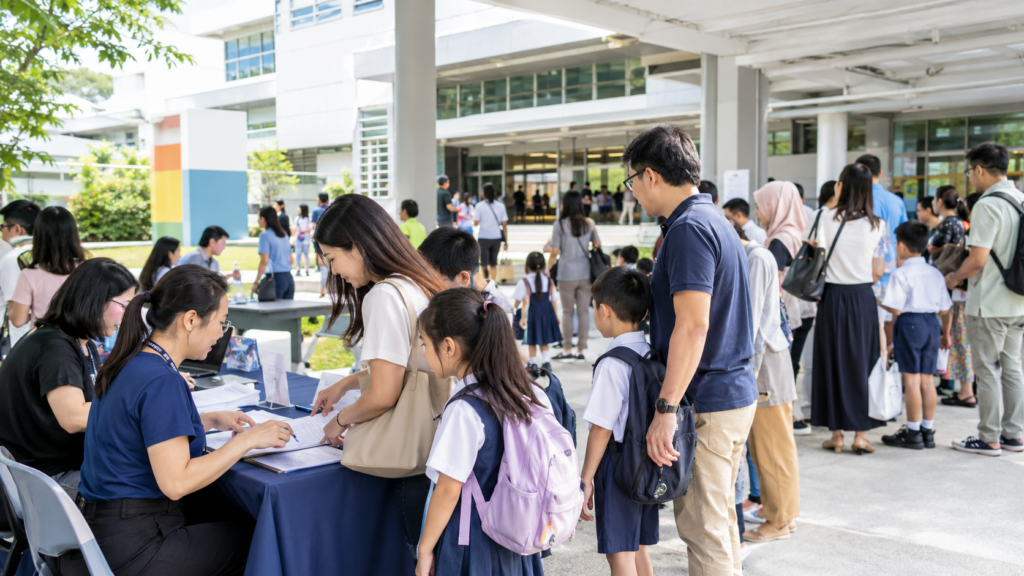
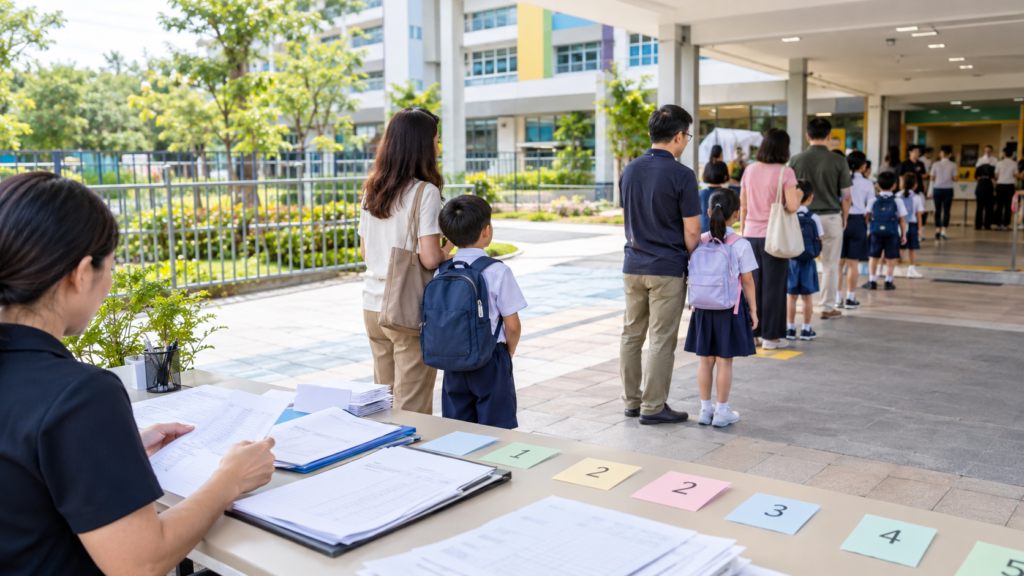
The P1 registration exercise is divided into different registration phases, and each phase has its own eligibility rules and applicant pool. So, a school may look more competitive in Phase 2B than in Phase 2C, or the other way around. When applications exceed the available P1 vacancies, balloting can be used to decide which applicants receive places. For parents, the ratio is useful for judging competition, but it should be viewed alongside the school’s location, programmes and registration eligibility.
Is There an Official MOE Primary School Ranking in Singapore?
No. MOE does not publish an official overall ranking that places Singapore primary schools from #1 to #179. The Ministry of Education Singapore provides information on P1 registration, school admission, vacancies and registration phases, but it does not issue a single league table ranking every primary school.
That’s why online primary school ranking lists can look quite different. Some websites rank schools using P1 demand and balloting, while others consider school programmes, affiliation, SAP/GEP, academic indicators or popularity. A school ranked #1 on one website may appear lower on another because the calculation is different. For parents, it’s better to check how a ranking was created before using it to guide school choice.
Phase 2B vs Phase 2C: Why School Rankings Can Differ
Phase 2B and Phase 2C are not measuring exactly the same group of applicants. That’s why a school can rank highly in one phase but look less competitive in another.
| Registration Phase | What It Measures |
| Phase 2B | Eligible community/affiliation-related applicants |
| Phase 2C | Open admission for eligible children |
| Balloting | Used when applications exceed available places |
For example, the 2026 Phase 2B demand ranking puts Nanyang Primary School at the top, followed by Ai Tong School and Pei Hwa Presbyterian Primary School.
| Rank | School |
| 1 | Nanyang Primary School |
| 2 | Ai Tong School |
| 3 | Pei Hwa Presbyterian Primary School |
| 4 | Holy Innocents’ Primary School |
| 5 | Kong Hwa School |
A school can rank highly in Phase 2B but not appear at the top of a Phase 2C ranking because the two phases serve different applicant groups. So, when comparing P1 registration figures, always check which registration phase the numbers come from.
Does a High Primary School Ranking Mean It Is the Best School?
Not necessarily. A high position in a demand-based ranking shows that many parents applied for the available places, but it doesn’t tell you whether the school is the best primary school in Singapore for your child. That’s where a proper primary school comparison matters.
Look at the school’s programmes, culture, CCAs, facilities, affiliation, SAP or relevant programmes, and location. Distance from home can also affect your P1 registration options, especially where balloting is involved. Check the school’s registration eligibility and past balloting history too.
So, does primary school ranking matter? Yes, it can show popularity and admission competition. But the best school for my child may be a different one. A school with a lower ranking can still be a much better fit for your child’s interests, learning style, daily routine and family circumstances.
What Parents Should Check Before Choosing a Primary School
A ranking can show demand, but your school choice Singapore decision should go a little deeper. Before submitting a primary school admission choice, check these six things:
- Check your P1 registration phase — Confirm which phase your child qualifies for under the current P1 registration Singapore rules.
- Look at recent vacancies and demand — Compare primary school vacancies with recent applicants to get a better idea of admission chances.
- Check past balloting — Recent P1 balloting results can show how competitive a school has been.
- Consider distance and registration rules — Check whether the school is within the 1km primary school or 2km primary school distance bands that apply to registration.
- Compare programmes and school environment — Look at school programmes, CCAs, facilities, culture and the areas your child enjoys.
- Look beyond the ranking — A popular school isn’t automatically the best fit. Compare several schools before deciding.
Frequently Asked Questions About Singapore Primary School Ranking
What is the top primary school in Singapore in 2026?
There is no official #1 primary school in Singapore. Using the demand-based method in this ranking, Princess Elizabeth Primary School leads the 2026 Phase 2C list with 3.98 applicants per vacancy.
Which primary school is hardest to get into in Singapore?
It depends on the registration phase. Based on 2026 Phase 2C demand, Princess Elizabeth Primary School had the highest applicants-per-vacancy ratio. Phase 2B has a different applicant group and can produce a different result.
What is the difference between Phase 2B and Phase 2C?
Phase 2B is for eligible applicants with specific community or affiliation-related links, while Phase 2C is open to eligible children who did not get a place in earlier phases. Since the applicant groups differ, their demand figures can differ too.
Does Singapore have an official primary school ranking?
No. MOE does not publish an official overall ranking that places Singapore primary schools from #1 to #179. Online lists use different measures, including P1 demand, programmes, affiliation and popularity.
Does high P1 demand mean a school is better?
No. High demand shows that many families want available places. It does not measure teaching quality or prove that a school is the best fit for your child.
How does primary school balloting work?
When applications exceed the available vacancies, balloting may be used to allocate places. The outcome depends on the applicable registration rules and priority criteria for that phase, so checking the latest MOE P1 registration information is important.
Final Takeaway
The Singapore primary school ranking is useful as a starting point, but it shouldn’t be treated as a final measure of school quality. For 2026, P1 demand gives parents a practical view of which schools are more competitive. But registration phase, balloting, distance from home, admission rules and school programmes can matter much more for an individual family. Use the ranking to shortlist schools, then compare the details that fit your child.