O-Level Periodic Table: How to Read It for Chemistry
The O-Level periodic table is a useful reference for Singapore-Cambridge O-Level Chemistry students. It helps you identify elements, work out electronic configurations, compare group properties and answer questions about chemical reactions. But simply knowing where an element appears on the table is not enough — you also need to understand what its position tells you. From proton numbers and electron arrangements to Group 1 reactivity and halogen properties, these notes cover the main concepts with simple examples, revision tables and practice questions aligned with the Singapore O-Level Chemistry syllabus.
TL;DR: O-Level Periodic Table — Key Facts
- Elements are arranged in increasing proton number.
- Groups run vertically; periods run horizontally.
- For main-group elements, group position helps explain outer-shell electrons.
- Period number indicates occupied electron shells for the elements studied at this level.
- Group 1 reactivity increases down the group, while Group 17 reactivity decreases.
- Learn to interpret the table and apply its information to Chemistry questions.
What Is the O-Level Periodic Table?
The periodic table of elements arranges chemical elements according to increasing proton number. Each element has its own symbol and position, and elements with related properties appear in the same group. This arrangement helps students recognise patterns in electronic configuration, chemical behaviour and reactivity. For Singapore-Cambridge O-Level Chemistry, the periodic table is more than a chart to look at during revision. It is a reference that can help you answer questions about element structure, ionic charges and group properties. Learning how to read it makes these topics easier to connect. And once you recognise the patterns, many questions become more straightforward.
How to Read an Element Box on the Periodic Table
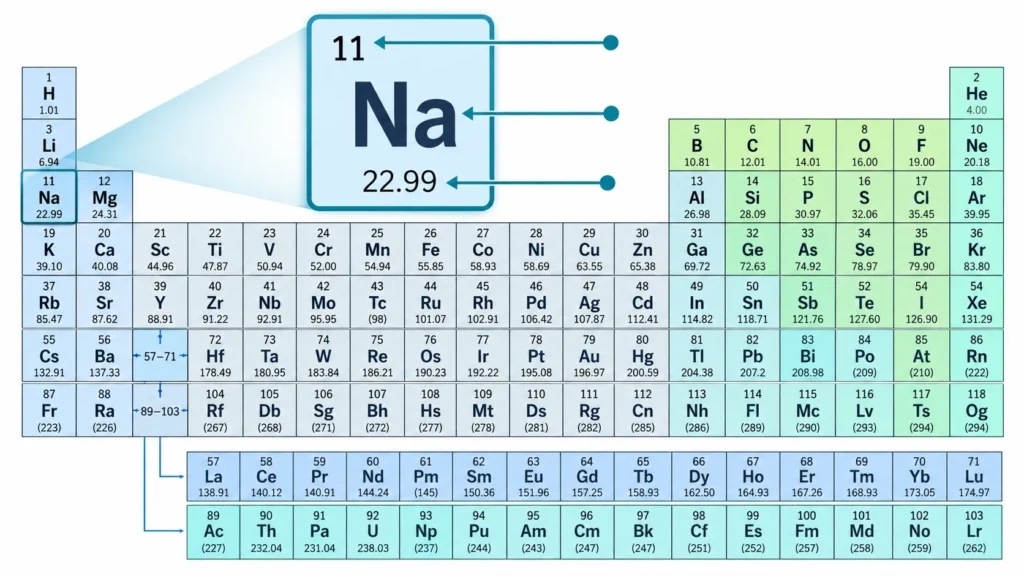
Each element has a box containing information that identifies it. The exact layout can vary, so check the labels rather than assuming every number has the same meaning.
| Term | Meaning |
|---|---|
| Chemical symbol | The one- or two-letter abbreviation for an element |
| Proton number | Number of protons in the nucleus |
| Mass number | Total number of protons and neutrons in one atom |
| Relative atomic mass | Average atomic mass relative to the carbon-12 standard |
For example, sodium (Na) has proton number 11. This tells you that every sodium atom contains 11 protons. A neutral sodium atom also has 11 electrons, because its positive and negative charges balance. Exam tip: Do not confuse proton number with mass number. Proton number identifies the element; mass number counts its protons and neutrons together.
Groups vs Periods: What Is the Difference?
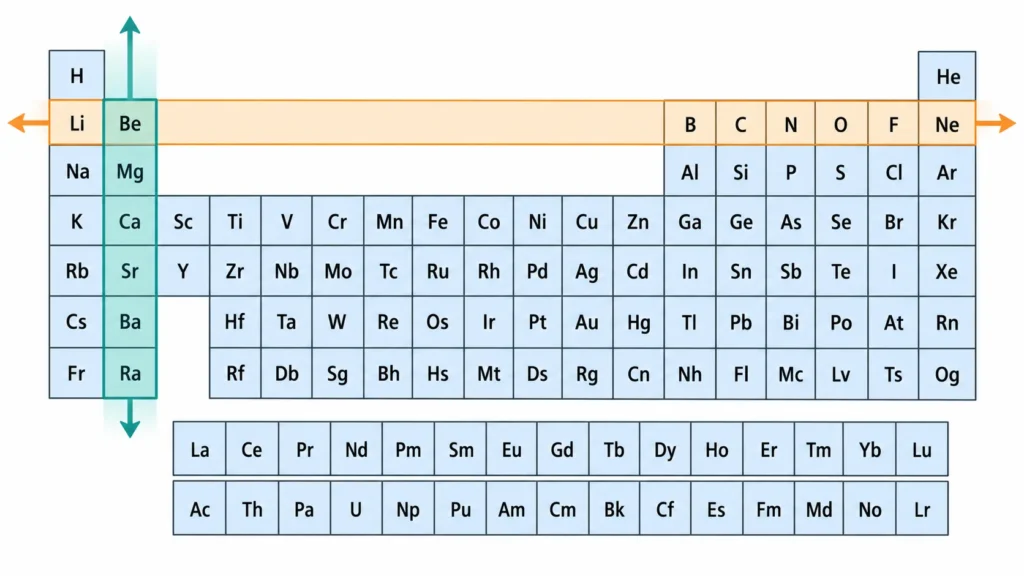
Groups and periods describe an element’s position on the periodic table. They also help you work out patterns in electron arrangement and chemical properties.
| Feature | Groups | Periods |
|---|---|---|
| Direction | Vertical columns | Horizontal rows |
| Main use | Compare properties of elements in the same group | Identify an element’s row and occupied shells |
| Example | Group 1 | Period 3 |
For the main-group elements studied at O-Level, the group number is linked to the number of outer-shell electrons, with some exceptions in how groups are numbered. The period number indicates the number of occupied electron shells in a neutral atom. For example, sodium has the electron arrangement 2,8,1. It has three occupied shells and one outer-shell electron, placing it in Period 3 and Group 1.
Electronic Configuration and Ionic Charges
Electronic configuration shows how electrons are arranged in an atom’s shells. For a neutral atom, the number of electrons equals the proton number. The first 20 elements are commonly represented using shell arrangements such as 2,8,1 or 2,8,7.
| Element | Proton number | Electron arrangement |
|---|---|---|
| Lithium (Li) | 3 | 2,1 |
| Oxygen (O) | 8 | 2,6 |
| Sodium (Na) | 11 | 2,8,1 |
| Chlorine (Cl) | 17 | 2,8,7 |
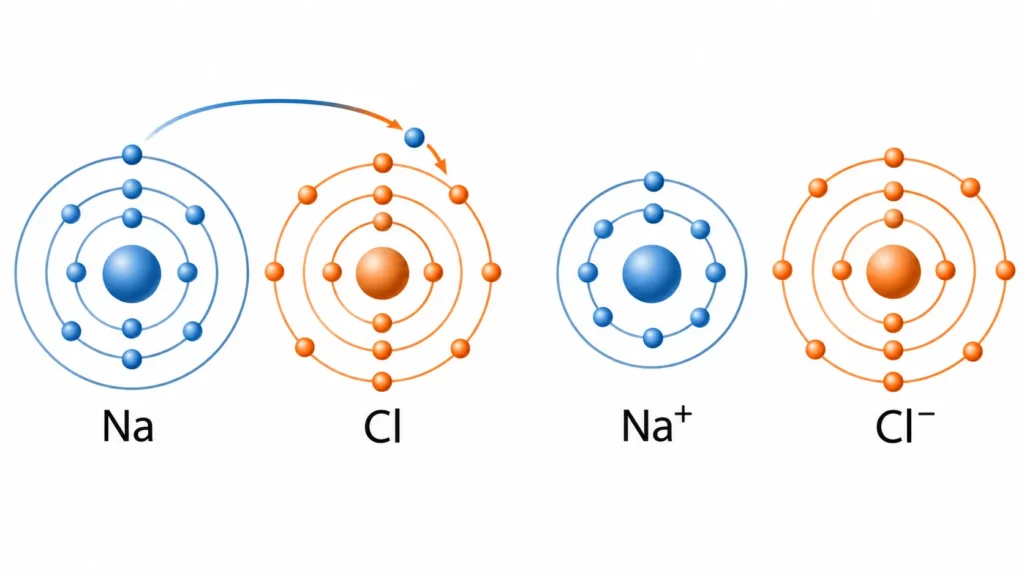
Sodium has one outer-shell electron. It can lose that electron to form a sodium ion, Na⁺, with the arrangement 2,8. Chlorine has seven outer-shell electrons and can gain one to form a chloride ion, Cl⁻, with the arrangement 2,8,8. These examples show how electron arrangements help explain ionic charge. For main-group elements, the number of outer-shell electrons can help you predict whether an atom is likely to lose or gain electrons when forming an ion. Check the specific question, though — not every element forms ions in the same way.
Important Periodic Trends for O-Level Chemistry
Periodic trends describe patterns in the properties of elements. For O-Level Chemistry, pay attention to the group properties included in your syllabus and be ready to explain the reason behind each trend.
| Group | Trend | What happens |
|---|---|---|
| Group 1: Alkali metals | Reactivity increases down the group | The outer electron is lost more readily |
| Group 17: Halogens | Reactivity decreases down the group | Gaining an electron becomes less favourable |
| Group 18: Noble gases | Generally unreactive | Their outer electron shells are stable |
Group 1: Alkali metals have one outer-shell electron. As you move down the group, the outer electron is farther from the nucleus and more shielded by inner electron shells. It becomes easier to lose, so reactivity increases. Group 17: Halogens have seven outer-shell electrons and tend to gain one electron during reactions. Down the group, the outer shell is farther from the nucleus and shielding increases. The attraction for an incoming electron becomes weaker, so reactivity decreases. Group 18: Noble gases have stable outer-shell arrangements, which makes them generally unreactive. Transition elements have their own characteristic properties, including the formation of coloured compounds and their use as catalysts in suitable reactions. Study the properties specified in the current Singapore-Cambridge O-Level Chemistry syllabus rather than trying to memorise every detail about every element.
How to Use the Periodic Table in O-Level Exam Questions
When a Chemistry question gives you an element’s proton number or position, use the information step by step.
- Find the proton number. For a neutral atom, this also gives you the number of electrons.
- Write the electron arrangement. Place the electrons in shells according to the rules taught in your course.
- Identify the group and period. Use the element’s position and electron arrangement to check your answer.
- Apply the group trend. If a question asks about reactivity, explain the change using electron loss, electron gain, shielding or attraction to the nucleus, as appropriate.
- Read the command word. “State” usually asks for a direct answer, while “explain” requires a reason. A common mistake is mixing up proton number and mass number. Another is stating that Group 1 reactivity increases down the group without explaining why. In structured questions, that extra reasoning can matter.
O-Level Periodic Table Practice Questions with Answers
A neutral atom has proton number 12. What is its electron arrangement?
Answer: 2,8,2. The atom has 12 electrons arranged across three shells. 2. Why do main-group elements in the same group often have similar chemical properties?
Answer: They have the same number of outer-shell electrons, so they tend to react in similar ways. 3. How does Group 1 reactivity change down the group?
Answer: It increases because the outer electron becomes easier to lose as distance from the nucleus and shielding increase.
Frequently Asked Questions
What is the O-Level periodic table used for?
It helps students identify elements, interpret proton numbers, work out electron arrangements and answer questions about group properties and periodic trends.
Do students need to memorise the periodic table for O-Level Chemistry?
The periodic table is provided in the Singapore-Cambridge O-Level Chemistry examination, but students still need to understand how to read and apply its information. Check the current SEAB syllabus for the applicable examination arrangements.
How do you identify groups and periods on the periodic table?
Groups are vertical columns and periods are horizontal rows. For main-group elements, group position helps indicate outer-shell electrons, while the period relates to occupied electron shells.
How can the periodic table help predict ionic charges?
For many main-group elements, outer-shell electrons help predict whether an atom is likely to lose or gain electrons to form an ion. Sodium, for example, commonly forms Na⁺, while chlorine commonly forms Cl⁻.
Conclusion
The O-Level periodic table becomes easier to use when you connect an element’s position with its proton number, electron arrangement and chemical properties. Revise the group trends, practise interpreting element boxes and explain the reasons behind your answers. Those habits will help you tackle periodic-table questions with greater confidence.