Secondary School Cut-Off Point 2024: Singapore School COP
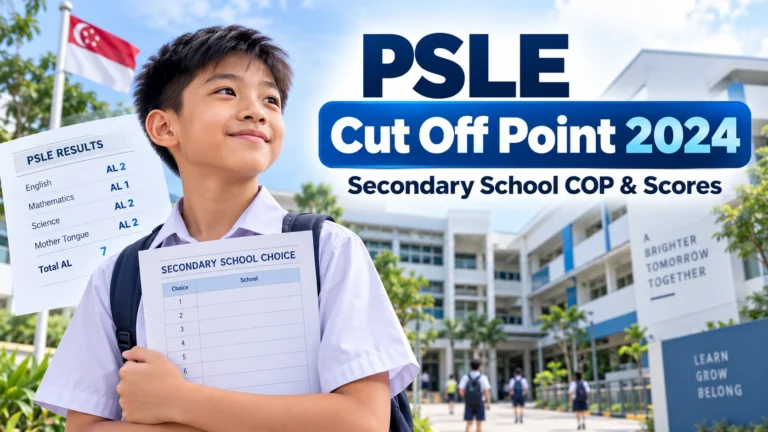
The secondary school cut-off point 2024 gives parents and students a useful reference for Secondary 1 school choices in Singapore. These figures relate to the 2024 Secondary 1 intake, for students who took the PSLE in 2023. There was no single cut-off point across all secondary schools, as the COP varied by school and programme. PSLE results are expressed through Achievement Levels (AL), with a lower total score representing a stronger result. Posting Group, Integrated Programme (IP), affiliation, school choices and admission demand can also affect the applicable range. Since these are historical figures, the 2024 COP should be treated as an indication rather than a guaranteed admission score. Next, we’ll compare 2024 COPs and explain how to use them when assessing secondary school choices.

TL;DR: Secondary School Cut-Off Point 2024
The secondary school cut-off point 2024 refers to the indicative PSLE Achievement Level (AL) score range for the 2024 Secondary 1 intake. COPs varied by school, programme and Posting Group, with affiliation also affecting some school choices. These figures are historical references based on the previous cohort, so a 2024 COP does not guarantee admission to the same school in another year.
What Was the Secondary School Cut-Off Point in 2024?
A secondary school cut-off point is the PSLE score of the last student admitted to a school or programme in a particular Secondary 1 intake. Singapore did not have one single nationwide COP in 2024. Each secondary school and programme had its own indicative PSLE score range, based on factors such as the school’s choices, vacancies and admission demand. The score is linked to the PSLE Achievement Level (AL), where a lower AL score indicates a stronger PSLE result. The 2024 COP reflects the admission outcome of the previous cohort and is best used as a reference when reviewing school choices. It can give parents an idea of how competitive a school was, but it should not be treated as a fixed requirement for future school admission.
Secondary School Cut-Off Points 2024 in Singapore
The secondary school COP 2024 varied across schools and programmes, so there isn’t one figure that applies to every student. For the 2024 Secondary 1 intake, the published PSLE cut-off points ranged from highly competitive IP schools with COPs around AL 6–8 to other G3 schools with higher score ranges. Some SAP schools also use Higher Chinese Language grades, shown as D (Distinction), M (Merit) or P (Pass) alongside the AL score.
2024 Secondary School COP Table
| Secondary School | 2024 COP | Programme / Posting Group |
| Raffles Girls’ School | AL 6 | IP |
| Raffles Institution | AL 6 | IP |
| Hwa Chong Institution | AL 7(D) | IP |
| Nanyang Girls’ High School | AL 7(D) | IP |
| National Junior College | AL 8 | IP |
| Anglo-Chinese School (Independent) | AL 7 | IP; G3 AL 8 |
| Dunman High School | AL 8(M) | IP |
| Catholic High School | AL 8(M) | IP; G3 AL 9(M) |
| Methodist Girls’ School | AL 6 | IP; G3 AL 8 |
| Singapore Chinese Girls’ School | AL 8 | IP; G3 AL 8 |
The figures above are drawn from published 2024 Secondary 1 COP data, with cross-checks against school and education-sector sources.

The table is arranged for easier comparison of historical 2024 COPs; it is not an official ranking by MOE. A lower COP generally shows that the last student admitted had a lower PSLE AL score, but it should not be treated as a measure of a school’s academic quality.
For parents comparing the Singapore secondary school COP, the programme also matters. For example, Anglo-Chinese School (Independent) had a 2024 IP COP of AL 7 and a G3 COP of AL 8 in published data. Affiliated and non-affiliated applicants can also have different indicative ranges at schools with affiliation.
So, the 2024 secondary school score range is best used as a historical reference when reviewing school choices. Compare your child’s PSLE AL score with the relevant programme and applicant category rather than relying on a single headline COP. The same school can have different figures for IP, G3, G2 or G1, and past admission results can change with each cohort.
How to Read a 2024 Secondary School COP
A secondary school COP shows the PSLE AL score of the last student admitted to a school or programme for a particular intake. A lower PSLE AL score means a stronger PSLE result, so a school with a lower historical COP generally had a more competitive admission outcome for that year. But COP is not a fixed entry requirement. It can shift with the cohort’s PSLE results, school choices, available vacancies and admission demand. For example, if a school had a historical COP of AL 10 and a child scored AL 9, the child’s score is stronger than that past benchmark. However, this does not guarantee admission in another admission exercise. A lower COP also does not automatically mean a school is better; it simply reflects a past admission outcome. The 2024 COP is not guaranteed for future cohorts.
IP, PG3, PG2 and PG1 Cut-Off Points Explained
The score ranges shown for secondary schools can differ depending on the programme or Posting Group offered. Here’s what the common terms mean:
| Term | Meaning |
| IP | Integrated Programme |
| PG3 | Posting Group 3 |
| PG2 | Posting Group 2 |
| PG1 | Posting Group 1 |
Posting Group 3 generally corresponds to students taking G3 subjects, while Posting Group 2 and Posting Group 1 correspond to G2 and G1 subjects under Full Subject-Based Banding (Full SBB). The PSLE score range used for admission can differ across these groups. An Integrated Programme (IP) is a separate six-year pathway offered by selected schools and may have its own indicative admission range. For parents comparing school choices, it’s important to check the specific programme and Posting Group rather than treating every published COP as the same benchmark.

Affiliated vs Non-Affiliated Secondary School COPs
Yes, school affiliation can affect the secondary school COP. An affiliated student is a student from a primary school that has an established affiliation with a particular secondary school. At some affiliated schools, these students may have a different indicative PSLE score range or admission consideration from non-affiliated students. This is why an affiliated secondary school cut-off point 2024 should not automatically be used when assessing options for everyone. Non-affiliated students should check the applicable non-affiliated secondary school COP instead. Affiliation does not apply to every school, and admission arrangements can differ. Parents should verify the school’s current affiliation status, eligibility conditions and admission requirements before using a past COP to plan their school choices.
Can You Get Into a School If Your PSLE Score Is Better Than Its 2024 COP?
Yes, a stronger PSLE score can put a student in a more favourable position, but the 2024 COP does not guarantee admission. For example, if a school recorded a COP of AL 10 in 2024 and a student has an AL 9, that score is stronger than the historical benchmark. Still, the result for a future admission exercise may differ. COPs reflect the previous cohort and can change based on student performance, school choices, demand and available vacancies. Parents should use the 2024 COP as a reference rather than a guaranteed threshold. It is also useful to consider the full list of school choices and the current admission information when planning for Secondary 1.
How to Use the 2024 COP When Choosing a Secondary School
The 2024 COP can give parents a useful starting point when reviewing Secondary 1 school choices, but it should be viewed alongside other factors. A student’s PSLE score compared with the historical COP can indicate how competitive a choice may have been for the previous cohort.
| Your PSLE Score vs Historical COP | How to Treat It |
| Better than COP | More favourable reference point |
| Around the COP | More competitive |
| Weaker than COP | Consider additional school choices |
When submitting Secondary 1 school choices, also look at school distance, programme options, affiliation, CCAs, subject offerings, school environment and your child’s interests. A school that fits your child well may be a better choice than relying on its past COP alone. Since admission outcomes can change from year to year, include a sensible mix of school choices rather than treating any historical COP as a guaranteed place.

Frequently Asked Questions About Secondary School COP 2024
What is the secondary school cut-off point 2024?
The 2024 secondary school cut-off point (COP) is the PSLE AL score of the last student admitted to a particular school or programme for the 2024 Secondary 1 intake. It is a historical reference, not a fixed national score.
Is the 2024 secondary school COP still useful?
Yes. It can help parents compare past admission outcomes and assess how competitive different school choices were. However, future COPs can differ based on each new cohort and admission exercise.
Does a lower secondary school COP mean the school is better?
Not necessarily. A lower COP indicates a stronger PSLE score was associated with the previous admission outcome. It does not by itself measure teaching quality, school culture or suitability for a student.
Does affiliation affect the secondary school cut-off point?
It can. Some affiliated schools have different indicative score ranges or admission considerations for affiliated and non-affiliated students. Parents should check the specific school’s current requirements.
Can the COP change from year to year?
Yes. COPs can change as student performance, school choices, admission demand and available vacancies vary between cohorts. A previous COP should not be treated as a guaranteed future threshold.
Final Thoughts on Secondary School Cut-Off Point 2024
The secondary school cut-off point 2024 remains useful as historical information when reviewing school choices. Parents can compare the past COP with their child’s PSLE score, while also checking the relevant Posting Group, programme and affiliation. Since admission outcomes can change between cohorts, a previous COP is not a guaranteed admission score. For Secondary 1, use the 2024 figures as one factor when comparing Singapore secondary schools, alongside programme fit, school environment and your child’s interests.