
Minimum Wage Singapore 2026: Salary Rates, PWM & Rules
Singapore does not have a nationwide minimum wage in 2026. Instead, the country uses the Local Qualifying Salary (LQS) and Progressive Wage Model (PWM) to set wage requirements for certain workers. From 1 July 2026, the full-time LQS increased to S$1,800 per month for eligible local employees. But the minimum salary in Singapore isn’t the same for everyone — it depends on the employer, industry, job role and employment status.
TL;DR: Minimum Wage Singapore at a Glance
- No national Minimum wage Singapore: Singapore has no universal statutory minimum wage.
- Full-time LQS: S$1,800 per month from 1 July 2026 for eligible local employees.
- Part-time LQS: S$10.50 per hour for covered local part-time workers.
- Progressive Wage Model: Mandatory wage rates apply to certain sectors and occupations.
- Foreign workers: Work Permit, S Pass and Employment Pass holders follow different employment and salary requirements.
Does Singapore Have a Minimum Wage in 2026?
No. Singapore does not have a single minimum wage that applies to every employee.
The Ministry of Manpower (MOM) generally allows employers and employees to agree on salaries through employment contracts. But certain wage rules still apply, particularly for local workers in covered industries and companies that employ foreign workers.
Singapore’s wage policy uses two main approaches. The Local Qualifying Salary sets a pay requirement for eligible local employees in firms hiring foreign workers, while the Progressive Wage Model establishes job-specific wages in selected sectors.
So, an office administrator, retail cashier and security officer may have different salary requirements. Their job classification and employer’s obligations matter more than a single national figure.

What Is the Minimum Salary in Singapore in 2026?
There isn’t one fixed minimum monthly salary in Singapore. The applicable amount depends on whether the employee falls under LQS, PWM or another employment requirement.
For example, an eligible full-time local employee working for a company that hires foreign workers must receive at least S$1,800 in gross monthly wages under LQS.
Singapore Minimum Salary Overview (2026)
| Wage category | Salary requirement |
|---|---|
| Nationwide minimum wage | No universal rate |
| Full-time LQS | S$1,800 per month |
| Part-time LQS | S$10.50 per hour |
| PWM minimum salary | Depends on sector and job role |
These amounts shouldn’t be treated as interchangeable. A retail worker covered by PWM may have a higher required salary than the general LQS amount.
And employees outside these schemes may have salaries determined by their employment contracts, subject to applicable employment laws.
Local Qualifying Salary (LQS) in Singapore
The Local Qualifying Salary is a wage requirement for companies employing foreign workers. It also affects how local employees are counted when employers calculate their foreign-worker quotas.
Who Is Covered by the LQS?
LQS applies to eligible Singapore citizens and permanent residents (PRs) working for employers that hire foreign workers.
These employers must meet the applicable LQS requirements for their local employees, even when those employees aren’t covered by a sector-specific PWM wage schedule.
Full-Time and Part-Time LQS Requirements
From 1 July 2026, the full-time LQS is S$1,800 in gross monthly wages.
For eligible part-time local employees, the hourly requirement is S$10.50.
Gross wages can include certain allowances and payments, so they’re not always identical to basic salary or take-home pay after CPF deductions.
The LQS also plays a role in local workforce count calculations. Employers need to check the relevant salary bands and employment conditions when determining how many local workers count towards their foreign-worker quota.
Progressive Wage Model (PWM) Explained
The Progressive Wage Model sets mandatory wage requirements for eligible local workers in selected industries and occupations.
Unlike a nationwide Minimum wage Singapore, PWM uses different wage schedules based on the worker’s role, job level and sector.
For example, a retail assistant and a security officer don’t necessarily have the same wage floor. Their required salaries follow separate schedules.
PWM also links wage progression with skills and training. Employers covered by the scheme must meet the applicable wage and training requirements.
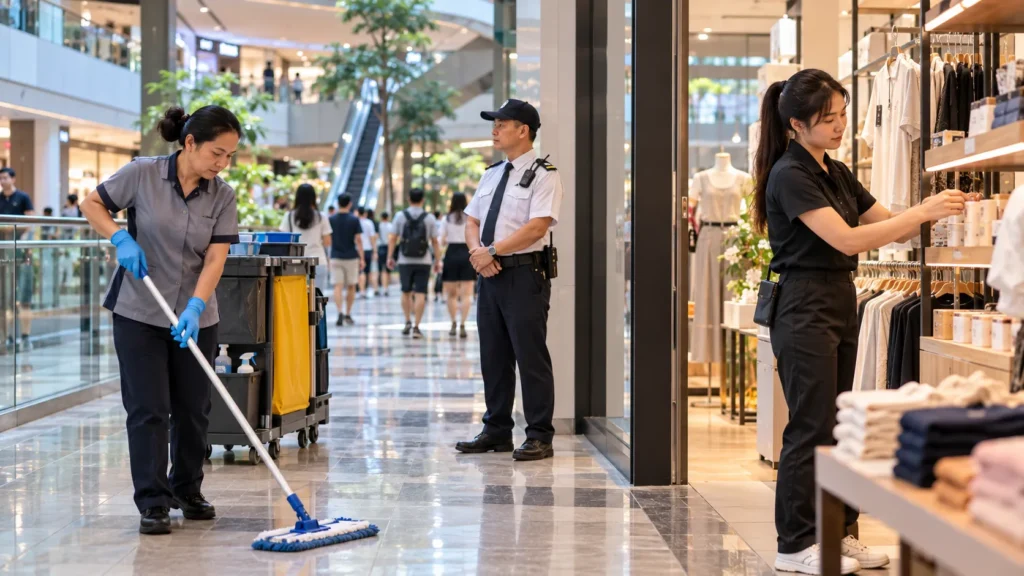
Singapore’s PWM covers sectors such as cleaning, security, retail and food services, along with certain occupations.
The aim is to support better wages as workers gain skills and experience, rather than applying one salary figure across every job.
Minimum Wage by Industry in Singapore (2026)
Some employees in Singapore are entitled to sector-specific wages under PWM. These rates can be higher than the Local Qualifying Salary.
Here are selected full-time job roles and their applicable 2026 wage amounts.
Selected PWM Salary Rates in Singapore
| Job role | Monthly wage |
|---|---|
| General cleaner (outsourced commercial premises) | S$2,080 |
| Retail assistant / cashier | S$2,435 |
| Security officer (outsourced) | S$3,090 |
| Food/drink stall assistant (quick services) | S$2,220 |
Note: These are selected 2026 PWM wage figures, not universal industry-wide salaries. The cleaning and outsourced security amounts refer to basic monthly wages, while the retail and food services amounts refer to gross monthly wages excluding overtime. Effective dates and job classifications differ.
A retail cashier, for instance, may fall under a different wage schedule from a supervisor working in the same shop.
And a cleaner’s wage requirement can depend on whether the employee works for an outsourced cleaning company or an in-house employer.
Employees should check their exact PWM job category before comparing their payslips with these figures.
Minimum Hourly Wage for Part-Time Workers
Singapore doesn’t have a universal minimum hourly wage for all part-time employees.
However, the part-time LQS requirement is S$10.50 per hour for eligible local workers employed by companies hiring foreign workers.
Consider a part-time employee working 20 hours weekly.
At S$10.50 per hour, the employee would earn S$210 for that week, before any applicable adjustments.
Over four weeks, that’s approximately S$840.
But this is only an illustration. Actual monthly earnings depend on hours worked, and employees covered by PWM may have different hourly wage requirements.
Part-time workers should check their employment terms and whether LQS or a sector-specific wage schedule applies.
Minimum Wage for Foreign Workers in Singapore
The minimum wage Singapore rules for foreign workers differ from those covering local employees.
Foreign employees aren’t automatically entitled to the Local Qualifying Salary, which is intended for eligible Singapore citizens and permanent residents.
Salary requirements also depend on the type of work pass.
Work Permit holders: Employers must follow the applicable Work Permit conditions and pay the salary declared to MOM. There isn’t one universal Work Permit minimum salary across all jobs.
S Pass holders: Applicants must meet the qualifying monthly salary required for their sector, age and application date.
Employment Pass holders: EP applicants face separate qualifying salary requirements, which also vary according to age and sector.
These work pass salary thresholds shouldn’t be confused with a national minimum wage.
Singapore Minimum Wage: 2025 vs 2026
The main change in 2026 was the increase in the full-time Local Qualifying Salary.
From 1 July 2026, the monthly LQS rose from S$1,600 to S$1,800 — an increase of S$200, or 12.5%.
LQS Salary Comparison: 2025 and 2026
| LQS category | 2025 | From 1 July 2026 |
|---|---|---|
| Full-time monthly LQS | S$1,600 | S$1,800 |
| Part-time hourly LQS | S$10.50 | S$10.50 |
| Full-time monthly increase | — | S$200 (12.5%) |
The part-time hourly LQS remained unchanged.
These figures reflect LQS requirements rather than a new nationwide minimum wage. Separate PWM wage schedules may also have changed during 2026.
What If Your Employer Pays Below the Required Wage?
If your salary appears lower than the applicable wage requirement, first check whether your job is covered by LQS or PWM.
You can take these steps:
- Check your eligibility: Confirm your employment category, job role and applicable wage schedule.
- Review your payslips: Compare your basic or gross wages against the relevant requirement.
- Check the Progressive Wage Portal: Eligible workers can use Singpass to access wage information through MOM’s portal.
- Speak with your employer: Ask for clarification if your salary appears incorrect.
If the issue remains unresolved, contact MOM or seek assistance through the Tripartite Alliance for Dispute Management (TADM), where appropriate.
Frequently Asked Questions About Minimum Wage Singapore
Is S$1,800 the minimum wage in Singapore?
No. S$1,800 is the full-time Local Qualifying Salary from July 2026 for eligible local employees in firms hiring foreign workers, not a nationwide minimum wage.
Does Singapore have a minimum hourly wage?
Singapore has no universal hourly minimum wage. However, LQS and certain PWM wage schedules specify hourly requirements for eligible employees.
What is the minimum wage for part-time workers in Singapore?
Eligible local part-time employees covered by LQS must receive at least S$10.50 per hour. Different requirements may apply to PWM-covered jobs.
Do foreign workers have a minimum wage in Singapore?
There is no single nationwide minimum wage for foreign workers. Salary and employment requirements depend on the work pass category and applicable rules.
Which industries are covered by the Progressive Wage Model?
PWM covers cleaning, security, retail, food services and other specified sectors and occupations, including certain administrative and driving roles.
How can I check my PWM salary in Singapore?
Use MOM’s Progressive Wage Portal with Singpass, or check the official PWM wage schedule for your sector, occupation and job level.
Minimum Wage Singapore 2026 — Key Takeaways
Singapore has no nationwide minimum wage in 2026, but specific salary requirements protect eligible workers. Since July 2026, the full-time Local Qualifying Salary has been S$1,800 per month, while the Progressive Wage Model sets higher job-specific wages in selected industries. Part-time employees and foreign workers may follow different rules depending on their employment arrangements. If you’re unsure which wage requirement applies to your job, check the latest salary information and eligibility conditions published by the Ministry of Manpower.