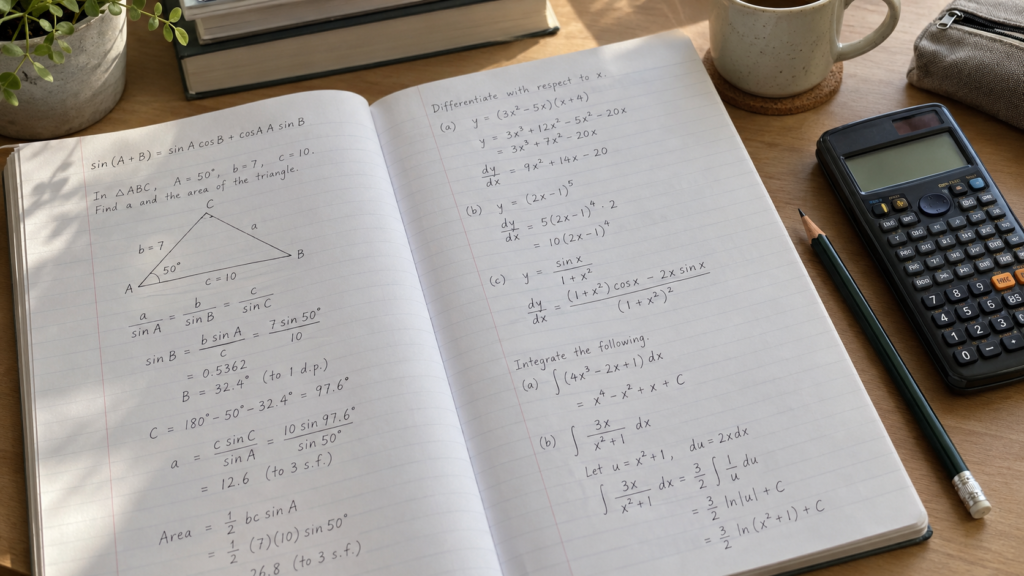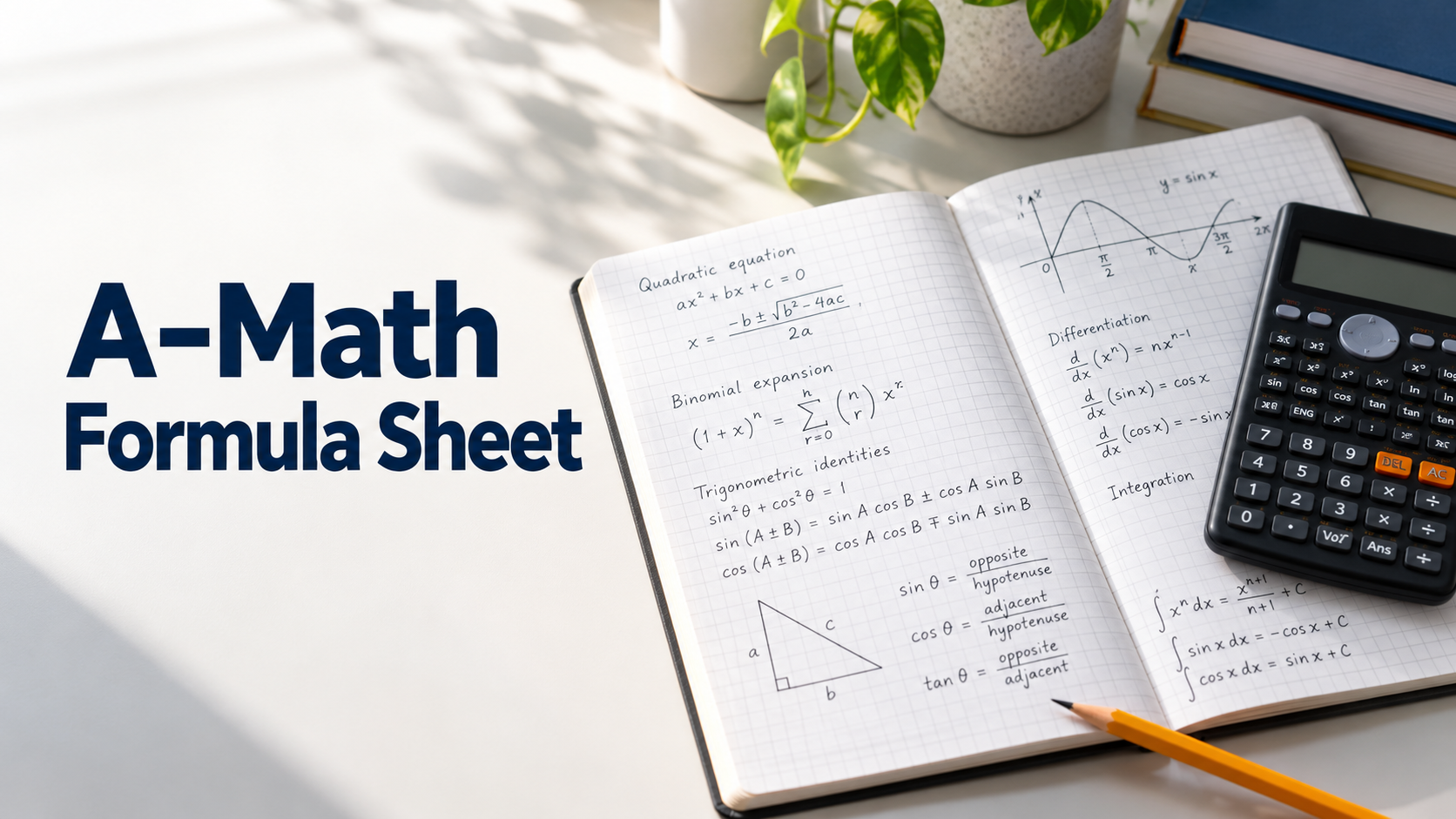
A-Math Formula Sheet: Complete Additional Mathematics Formulas
Singapore Secondary 3 and Secondary 4 students preparing for O-Level Additional Mathematics need more than a list of equations. An A-Math formula sheet gives you a quick way to review important results, check mathematical relationships and prepare for exam questions. But knowing a formula and knowing when to use it are two different things. You may remember the quadratic formula perfectly and still lose marks through a sign error or incorrect substitution. This revision resource covers key A-Math formulas, exam formula guidance, common mistakes and practical revision tips for Singapore students.
TL;DR: A-Math Formula Sheet at a Glance
- Algebra: Revise quadratic equations, discriminants and binomial expansion.
- Trigonometry: Practise identities, the sine rule, cosine rule and triangle area.
- Calculus: Review differentiation, integration and their applications.
- Exam preparation: Check which mathematical formulae are supplied and which results you need to learn.
- Revision tip: Practise applying formulas to questions, not just memorising them.
Your current examination syllabus determines which formulae are provided. Check the relevant SEAB syllabus for your exam year.
Important A-Math Formulas for O-Level
These formulas cover several important Additional Mathematics topics. Use them as a revision reference alongside your school notes and syllabus.
1. Quadratic Formula and Discriminant
For a quadratic equation \(ax^2+bx+c=0\), where \(a\ne0\), the quadratic formula is:
\[ x=\frac{-b\pm\sqrt{b^2-4ac}}{2a} \]
The discriminant is:
\[ \Delta=b^2-4ac \]
| Discriminant | Nature of roots |
|---|---|
| \(\Delta>0\) | Two distinct real roots |
| \(\Delta=0\) | Two equal real roots |
| \(\Delta<0\) | No real roots |
Use the discriminant when a question asks about the number or nature of roots, especially when a parameter is involved.
2. Binomial Expansion
For a positive integer \(n\), the binomial theorem gives:
\[ (a+b)^n=\sum_{r=0}^{n}\binom nr a^{n-r}b^r \]
The general term is:
\[ T_{r+1}=\binom nr a^{n-r}b^r \]
Here, \(\binom nr\) represents a binomial coefficient. The general term is useful when a question asks for a particular term or the coefficient of a specified power of \(x\).

3. Trigonometric Identities
These identities are useful when simplifying expressions and solving trigonometric equations.
| Identity | Formula |
|---|---|
| Pythagorean identity | \(\sin^2\theta+\cos^2\theta=1\) |
| Tangent identity | \(\tan\theta=\frac{\sin\theta}{\cos\theta}\) |
| Double-angle identity | \(\sin 2\theta=2\sin\theta\cos\theta\) |
| Cosine double-angle | \(\cos 2\theta=\cos^2\theta-\sin^2\theta\) |
Remember that trigonometric identities are relationships between expressions. You may need to rearrange them before applying them to a question.
4. Sine Rule, Cosine Rule and Triangle Area
For a triangle with sides \(a,b,c\) opposite angles \(A,B,C\):
\[ \frac a{\sin A}=\frac b{\sin B}=\frac c{\sin C} \]
The cosine rule is:
\[ a^2=b^2+c^2-2bc\cos A \]
The area of a triangle can be calculated using:
\[ \text{Area}=\frac12bc\sin A \]
Use the sine rule when you know a suitable side-angle pair. The cosine rule is useful when two sides and the included angle are known, or when all three sides are given and an angle is required. The triangle-area formula needs two sides and their included angle.
5. Differentiation Formulas
Differentiation helps students find gradients, equations of tangents and normals, stationary points, and rates of change.
| Function | Derivative |
|---|---|
| \(y=x^n\) | \(\frac{dy}{dx}=nx^{n-1}\) |
| \(y=\sin x\) | \(\frac{dy}{dx}=\cos x\) |
| \(y=\cos x\) | \(\frac{dy}{dx}=-\sin x\) |
| \(y=e^x\) | \(\frac{dy}{dx}=e^x\) |
| \(y=\ln x\) | \(\frac{dy}{dx}=\frac1x\) |
For example, if \(y=x^3+2x^2-5x\), then:
\[ \frac{dy}{dx}=3x^2+4x-5 \]
At a stationary point, set \(\frac{dy}{dx}=0\) and solve for \(x\). Check the question carefully before deciding whether the point is a maximum, minimum or another type of stationary point.
6. Integration Formulas
Integration is used to find antiderivatives and, in suitable problems, areas under curves.
| Function | Integral |
|---|---|
| \(x^n\), where \(n\ne-1\) | \(\int x^n\,dx=\frac{x^{n+1}}{n+1}+C\) |
| \(\frac1x\) | \(\int\frac1x\,dx=\ln|x|+C\) |
| \(\cos x\) | \(\int\cos x\,dx=\sin x+C\) |
| \(\sin x\) | \(\int\sin x\,dx=-\cos x+C\) |
The constant \(C\) matters when finding an indefinite integral. For definite integrals, substitute the upper and lower limits into an antiderivative and subtract the lower result from the upper result. Check the limits and signs before writing your final answer.
7. Coordinate Geometry and Circle Equations
Some useful coordinate geometry relationships include:
| Concept | Formula |
|---|---|
| Gradient | \(m=\frac{y_2-y_1}{x_2-x_1}\) |
| Midpoint | \(\left(\frac{x_1+x_2}{2},\frac{y_1+y_2}{2}\right)\) |
| Distance | \(\sqrt{(x_2-x_1)^2+(y_2-y_1)^2}\) |
| Circle with centre \((a,b)\) | \((x-a)^2+(y-b)^2=r^2\) |
Use the gradient formula to find the slope of a straight line. The distance and midpoint formulas are useful when working with two points. For circle questions, identify the centre and radius before substituting coordinates. Check your current syllabus to confirm which results and methods apply to your examination.
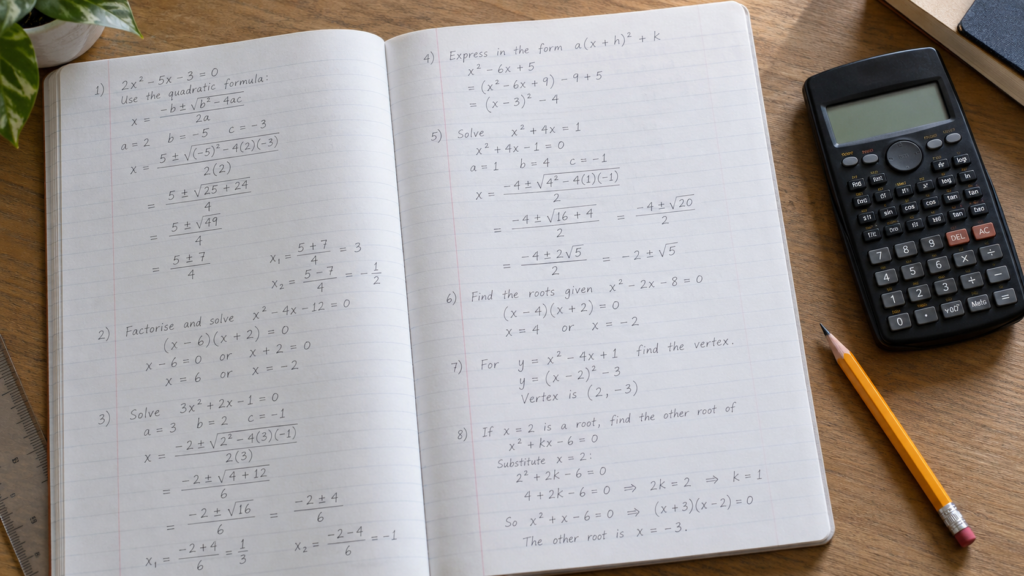
A-Math Formulas Given in the Exam vs Formulas to Memorise
Singapore students should know the difference between a formula printed in an examination reference and mathematical knowledge they are expected to recall or apply. The exact requirements depend on the syllabus and examination year.
| Formula or topic | Revision action |
|---|---|
| Formulae explicitly supplied in the examination | Learn what each symbol means and practise using the formula |
| Quadratic equations | Practise solving equations and interpreting the discriminant |
| Binomial expansion | Understand coefficients and how to identify a particular term |
| Trigonometric identities | Practise rearranging identities and solving equations |
| Differentiation and integration | Revise standard results and the required rules |
| Coordinate geometry | Practise gradients, equations of lines and relevant circle problems |
Don’t assume that every formula from a topic will be printed on the examination paper. Check the current SEAB Additional Mathematics syllabus and its mathematical formulae section for the rules that apply to your exam. A formula sheet is a revision aid, not a replacement for understanding the methods.
How to Use an A-Math Formula Sheet Effectively
A formula sheet is most useful when you practise with it regularly. Try these five steps during revision:
- Identify the topic. Decide whether the question involves algebra, trigonometry, calculus or coordinate geometry.
- Look for the required result. Identify what the question asks you to find before choosing a formula.
- Write the formula first. This helps you organise your working and reduces substitution errors.
- Substitute carefully. Pay attention to negative signs, brackets, powers and calculator settings.
- Check your answer. Where possible, substitute the result back into the original equation or use another method to check it. And don’t spend every revision session just reading formulas. Cover the answer column and try recalling each result from memory. Then solve a few school practice questions or past-year questions without looking at your notes. This gives you a better idea of which topics need more work.
Common A-Math Formula Mistakes
| Common mistake | How to avoid it |
|---|---|
| Missing a negative sign in the quadratic formula | Write the full formula before substituting values |
| Mixing up trigonometric identities | Check the identity and rearrange it one step at a time |
| Forgetting \(+C\) in an indefinite integral | Check whether the integral is indefinite or definite |
| Using the wrong angle unit | Follow the question’s instructions and check calculator mode |
| Applying a formula without checking its conditions | Identify the known values and confirm the formula fits the problem |
Small errors can affect an otherwise correct solution. Show your working clearly, especially in multi-step questions. And if the same mistake appears twice in your practice, write it in a separate error log and review it before your next revision session.
Frequently Asked Questions
1. What is an A-Math formula sheet?
An A-Math formula sheet is a quick-reference resource containing mathematical formulas and relationships used in Additional Mathematics. Students use it to revise topics such as algebra, trigonometry, differentiation and integration.
2. Can I download an A-Math formula sheet PDF in Singapore?
Students can look for A-Math formula sheet PDFs from educational websites and tuition providers. Check the syllabus year and accuracy before using a downloaded resource. A printable PDF should be provided only when an actual file is available.
3. Which formulas are provided in the O-Level A-Math examination?
The formulae supplied depend on the applicable examination syllabus. Check the current SEAB syllabus and mathematical formulae section rather than relying on an old revision sheet.
4. Which A-Math formulas should I memorise?
Revise the formulas, identities, rules and methods required by your syllabus. Pay particular attention to standard differentiation and integration results, algebraic methods and trigonometric relationships, while checking which results are explicitly supplied in the examination.
5. How should Secondary 3 and Secondary 4 students revise A-Math formulas?
Group formulas by topic, practise recalling them, solve questions without notes and review errors. Secondary 4 students can also use timed practice to build familiarity with examination questions.
6. Where can I find the official SEAB Additional Mathematics syllabus?
Look for the Singapore Examinations and Assessment Board (SEAB) syllabus for Additional Mathematics that matches your examination year. Check the syllabus code and publication year before relying on a formula list.
Final Revision Reminder
Keep your A-Math formula sheet accessible during revision, but practise applying the formulas rather than only reading them. Review mistakes, work through questions from different topics and check the syllabus for your examination year. A little regular practice can make formula selection feel much more familiar during exams.