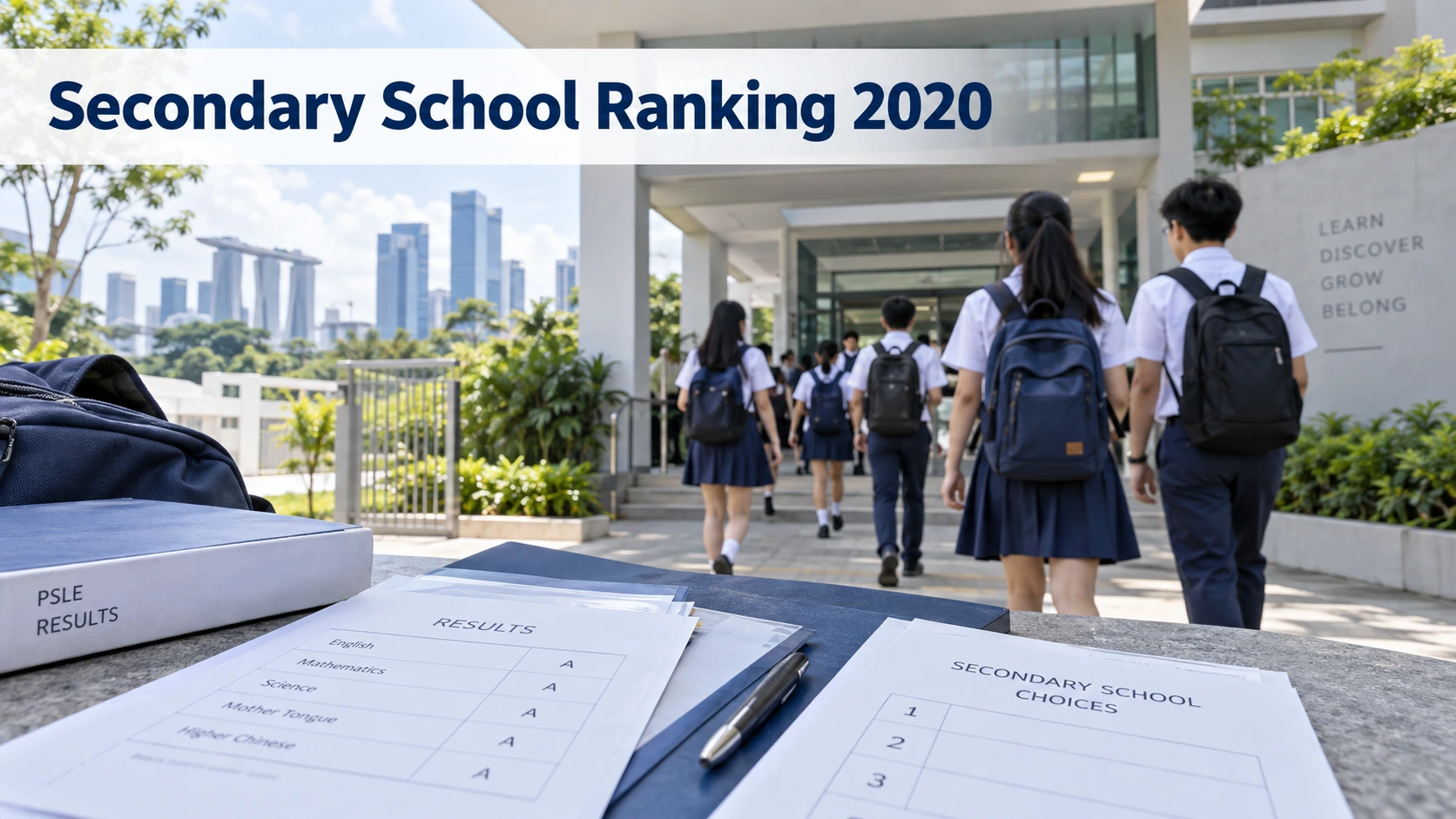
Secondary School Ranking 2020: Singapore Schools by PSLE COP
The secondary school ranking 2020 refers to Singapore secondary schools compared using their historical PSLE cut-off points (COP) for the 2020 Secondary 1 intake. The figures come from the PSLE T-score system used at that time, so they should not be read like today’s Achievement Level (AL) scores. A COP shows the score of the last student admitted to a school in that posting exercise. It is useful as a historical admission benchmark, but it was never an official measure of school quality. For parents researching old school choices, the Singapore secondary school ranking can still provide a helpful starting reference — especially when comparing programmes, school types and past admission patterns.

TL;DR: Secondary School Ranking 2020 at a Glance
The 2020 ranking is based on PSLE COPs for the 2020 Secondary 1 intake. Raffles Girls’ School and Nanyang Girls’ High School recorded the highest listed COP at 261, followed by Raffles Institution at 259. These figures belong to the old PSLE T-score system, not today’s AL scoring. A COP reflects an admission outcome, not an official ranking of school quality.
Secondary School Ranking 2020 by PSLE Cut-Off Point
The table below uses the historical 2020 Secondary 1 intake figures reported for Singapore secondary schools. The list is arranged by the published COP, with separate entries where a school had different programmes or admission pathways with different cut-off points. This matters because a single school could have different historical COPs for IP and O-Level routes.
In 2020, students were still using the PSLE T-score system when entering the S1 Posting Exercise. The COP was tied to the last student admitted, so a higher numerical T-score represented a stronger historical admission benchmark under that system. The figures should not be compared directly with today’s PSLE Score or AL bands.
| Rank | Secondary School | 2020 COP | Programme | School Type |
| 1 | Raffles Girls’ School (Secondary) | 261 | IP | Girls’ |
| 2 | Nanyang Girls’ High School | 261 | IP, SAP | Girls’ |
| 3 | Raffles Institution | 259 | IP | Boys’ |
| 4 | Hwa Chong Institution | 257 | IP, SAP | Boys’ |
| 5 | CHIJ St. Nicholas Girls’ School | 257 | IP, SAP | Girls’ |
| 6 | Methodist Girls’ School (Secondary) | 257 | IB | Girls’ |
| 7 | Anglo-Chinese School (Independent) | 256 | IB | Boys’ |
| 8 | Dunman High School | 255 | IP, SAP | Co-ed |
| 9 | National Junior College | 254 | IP | Co-ed |
| 10 | River Valley High School | 253 | IP, SAP | Co-ed |
| 11 | Cedar Girls’ Secondary School | 253 | IP | Girls’ |
| 12 | CHIJ St. Nicholas Girls’ School | 253 | O-Level, SAP | Girls’ |
| 13 | Methodist Girls’ School (Secondary) | 253 | O-Level | Girls’ |
| 14 | Victoria School | 252 | IP | Boys’ |
| 15 | Catholic High School | 252 | IP, SAP | Boys’ |
| 16 | Singapore Chinese Girls’ School | 252 | IP | Girls’ |
| 17 | Singapore Chinese Girls’ School | 252 | O-Level | Girls’ |
| 18 | Anglo-Chinese School (Independent) | 252 | O-Level | Boys’ |
| 19 | St. Joseph’s Institution | 251 | IB | Boys’ |
| 20 | Temasek Junior College | 250 | IP | Co-ed |
The list shows why simply searching for a school name and one COP can be misleading. CHIJ St. Nicholas Girls’ School, Methodist Girls’ School and Anglo-Chinese School (Independent), for example, appear with different figures for different programmes. The historical COP is best treated as a snapshot of secondary school admission for that particular intake.
Historical note: These figures are for the 2020 intake and should not be used as a current admission guide. Actual COPs can change from year to year because they depend on the PSLE results and school choices of that particular cohort.
How Was the Secondary School Ranking 2020 Calculated?
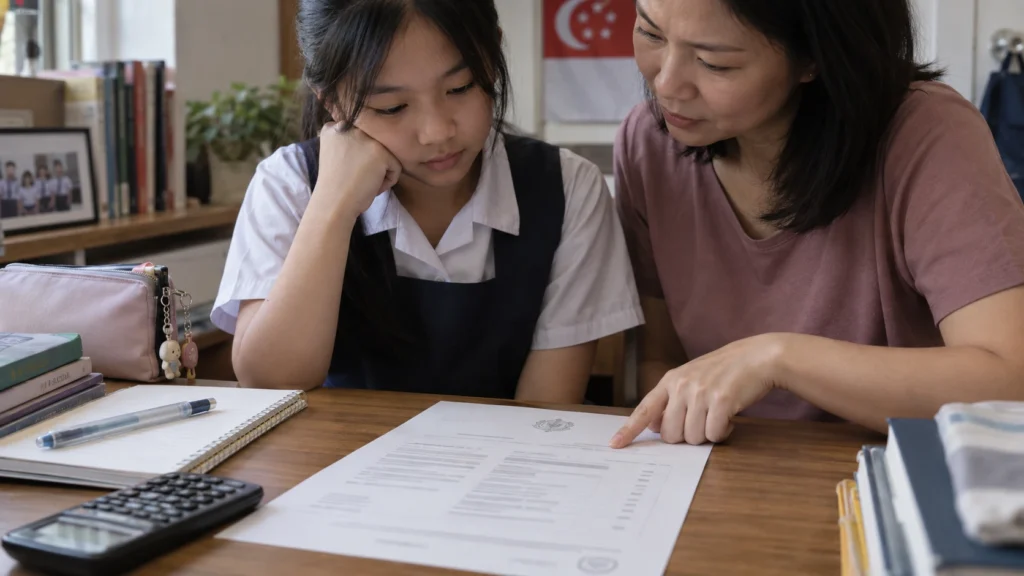
The historical list ranks schools by their reported PSLE cut-off point for the 2020 Secondary 1 intake. In simple terms, the COP represented the PSLE score of the last student admitted through the relevant posting exercise. It was not fixed in advance.
The S1 Posting Exercise involved students listing their secondary school choices after receiving their PSLE results. The final admission score could shift according to that year’s results, school preferences and available places. This is why a COP from one intake should not be treated as a guaranteed admission score for another.
What Is a PSLE Cut-Off Point (COP)?
A PSLE COP is the score associated with the last student posted to a school for a particular intake. For the 2020 T-score system, the score was based on the PSLE aggregate or T-score.
So, the secondary school cut-off points in this ranking are historical admission benchmarks. They tell readers where the last admitted student stood in that particular posting exercise — not how a school performs academically as an institution.
The 2020 PSLE T-Score System
The 2020 cohort used the older T-score system. This is different from the Achievement Level scoring system introduced for the 2021 PSLE cohort. MOE later used 2020 cohort results to simulate indicative PSLE Score ranges for the transition to the new system, but those simulated figures were not the original 2020 admission scores.
Higher Chinese Language also mattered in certain SAP school admission contexts. Historical information from the 2020 ranking shows bonus points could be added to the T-score for eligible students taking Higher Chinese, with the bonus depending on the HCL grade.
Top 10 Secondary Schools in Singapore in 2020
The first ten entries give a quick picture of the highest reported COPs in the 2020 intake. These are historical figures, not a current school ranking.
Raffles Girls’ School
2020 COP: 261 | IP | Girls’ school
Raffles Girls’ School recorded a COP of 261 for the 2020 intake. Its listed pathway was the Integrated Programme, a six-year route that does not follow the standard O-Level route at the secondary stage.
Nanyang Girls’ High School
2020 COP: 261 | IP, SAP | Girls’ school
Nanyang Girls’ High School also recorded 261. The school was listed under the Integrated Programme and Special Assistance Plan, making Higher Chinese relevant to its historical SAP admission context.
Raffles Institution
2020 COP: 259 | IP | Boys’ school
Raffles Institution recorded a 259 COP for its 2020 Secondary 1 intake and was listed with the Integrated Programme.
Hwa Chong Institution
2020 COP: 257 | IP, SAP | Boys’ school
Hwa Chong Institution had a reported COP of 257. Its 2020 listing included both IP and SAP classifications.
CHIJ St. Nicholas Girls’ School
2020 COP: 257 for IP | Girls’ school
CHIJ St. Nicholas Girls’ School appeared twice in the historical list because its IP and O-Level pathways had different COPs. The IP entry was 257, while the O-Level entry was 253.
Methodist Girls’ School
2020 COP: 257 for IB | Girls’ school
Methodist Girls’ School recorded 257 for its IB pathway. Its O-Level entry appeared separately at 253, another example of why programme-specific figures matter.
Anglo-Chinese School (Independent)
2020 COP: 256 for IB | Boys’ school
Anglo-Chinese School (Independent) recorded 256 for the IB pathway and 252 for its O-Level entry in the same historical table.
Dunman High School
2020 COP: 255 | IP, SAP | Co-ed
Dunman High School recorded 255 and was listed as a co-educational IP and SAP school.
National Junior College
2020 COP: 254 | IP | Co-ed
National Junior College recorded a COP of 254 for the 2020 intake and offered the Integrated Programme pathway shown in the historical ranking.
River Valley High School
2020 COP: 253 | IP, SAP | Co-ed
River Valley High School recorded 253 and was listed under both the Integrated Programme and SAP.
What Should Parents Consider Besides COP?
A historical COP can narrow a school list, but parents also had other factors to weigh during secondary school selection. MOE’s guidance for the 2020 S1 Posting Exercise specifically pointed families toward distinctive programmes, CCAs, school ethos and culture when considering school choices.
Integrated Programme (IP)
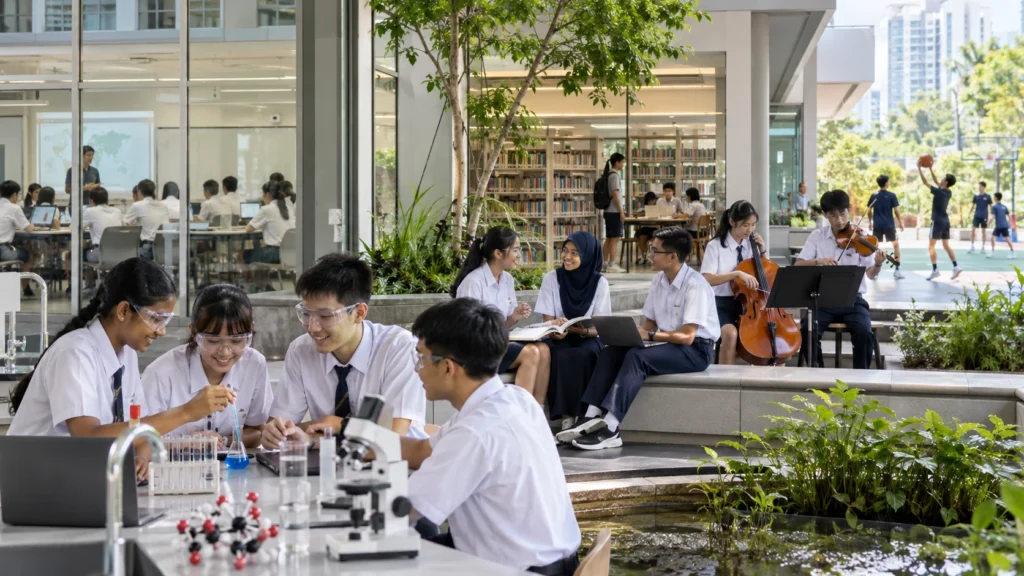
The Integrated Programme is a six-year secondary-to-pre-university pathway. Students generally do not sit for the GCE O-Level examination at the end of Secondary 4, following the programme’s integrated curriculum toward pre-university studies.
SAP and Higher Chinese
The Special Assistance Plan (SAP) applies to designated schools offering a bilingual education environment with an emphasis on Chinese language and culture. Higher Chinese Language can also matter in SAP admission, with historical HCL grades and bonus-point rules forming part of the 2020 context.
IB and Other Programmes
The International Baccalaureate (IB) was another pathway shown in the 2020 ranking, including at Methodist Girls’ School and Anglo-Chinese School (Independent). Other schools followed the O-Level route or offered distinctive programmes. Looking only at the COP can hide these differences.
Affiliation, CCAs and Distance From Home
An affiliated primary school could matter during the posting process because affiliated pupils had an advantage in certain school admission situations. The 2020 historical ranking source also highlighted affiliation as a factor for parents to consider.
Distance from home, CCAs, school culture, ethos and the programmes offered are also practical parts of school preferences. MOE specifically advised parents and students to consider these factors when making secondary school choices.
2020 Secondary School Ranking vs Today’s PSLE System
The 2020 figures belong to a different scoring system, so direct score comparisons can create confusion.
| Feature | 2020 | Current System |
| PSLE scoring | T-score | Achievement Level (AL) scoring |
| Secondary school admission | S1 Posting Exercise | S1 Posting Exercise |
| COP reference | Historical T-score-based admission outcome | PSLE Score-based admission outcome |
| Direct score comparison | Not appropriate | Current scores use AL bands |
| Main use of old figures | Historical school-choice reference | Current school-choice reference |
MOE introduced the new PSLE scoring system from the 2021 cohort. The 2020 cohort still received results in T-score terms, which is why the old secondary school ranking 2020 should be kept separate from current PSLE score ranges.
Was There an Official MOE Secondary School Ranking in 2020?
No official MOE list should be described as a ranking of Singapore secondary schools from #1 onward based on school quality. The historical tables commonly called a “secondary school ranking” were generally comparisons based on admission COPs.
That distinction matters. A school appearing higher because its historical COP was higher does not establish that it was officially declared better by MOE. The COP records an admission outcome for a particular cohort and posting exercise. MOE’s own material also states that actual COPs can vary according to PSLE results and school choices each year.
FAQs
What was the top secondary school in Singapore in 2020?
Using the historical COP-based ranking, Raffles Girls’ School and Nanyang Girls’ High School shared the highest listed 2020 COP at 261. This refers to the relevant 2020 Secondary 1 intake data, not an official MOE school-quality ranking.
What was the highest secondary school COP in 2020?
The highest COP in the published 2020 intake table was 261, recorded by Raffles Girls’ School and Nanyang Girls’ High School.
What was the PSLE cut-off point for secondary schools in 2020?
There was no single COP for every secondary school. Each school, and in some cases each programme within a school, had its own historical admission outcome. The 2020 table ranged from 261 among the highest entries, with different COPs across schools and programmes.
How were secondary schools ranked in 2020?
The commonly published 2020 ranking was based on PSLE cut-off points for the 2020 Secondary 1 intake. Schools were arranged according to the reported COP, rather than an MOE assessment of school quality.
Is the 2020 secondary school ranking an official MOE ranking?
No. It is better described as a historical COP-based comparison. MOE provides school admission and posting information, but the COP itself is an outcome of a particular cohort’s PSLE results and school choices.
Can 2020 COPs be compared with today’s PSLE scores?
Not directly. The 2020 cohort used the T-score system, while the PSLE moved to Achievement Level scoring from the 2021 cohort. Historical T-score COPs and current AL-based scores belong to different scoring systems.
Final Takeaway
The secondary school ranking 2020 is most useful as a historical record of Singapore school admission patterns. Its COP figures show the scores associated with the last students admitted during the 2020 Secondary 1 posting exercise, with some schools showing different figures for different programmes. The list also reflects the old PSLE T-score system, so those numbers should not be treated as current AL scores.
For parents reviewing past school choices, COP is one reference point among several. IP, SAP, IB, O-Level pathways, affiliation, CCAs, school culture and distance from home can all change how a school fits a particular student.