Good Secondary Schools in Singapore: 15 Schools Worth Shortlisting in 2026
Searching for good secondary schools in Singapore after PSLE? A strong shortlist should look beyond a school’s COP. Academic programmes, CCA options, school culture, location and the pathway offered can all shape how well a school suits your child.
There is no single school that is the best fit for every student. A child who enjoys Maths and Science may prefer a school with a strong STEM focus, while another may do better in an arts, sports or bilingual setting. PSLE results still matter, of course, especially when you are checking realistic school choices. But they are only one part of the picture. The aim is to find schools that match your child’s abilities, interests and day-to-day needs — not just chase the lowest COP.

Good Secondary Schools in Singapore: Quick Comparison
Need a quick starting point? These 15 secondary schools in Singapore stand out for different reasons, from academic programmes and bilingual learning to STEM, arts and sports. The list is not an official national ranking. Instead, it gives parents a practical mix of established IP schools, SAP schools and specialised options to research further based on their child’s interests and PSLE pathway.
| School | Standout Area | Pathway / Focus | May Suit Students Who… |
| Raffles Institution | Academics | IP | Want a highly academic environment |
| Hwa Chong Institution | Academics & languages | IP | Value academic and bilingual learning |
| Nanyang Girls’ High | Academics | IP/SAP | Want a girls’ school with strong academics |
| Raffles Girls’ School | Academics & leadership | IP | Seek academic challenge |
| ACS (Independent) | IB | IP/IB | Want an IB pathway |
| Dunman High School | Bilingual education | IP/SAP | Prefer a bilingual environment |
| Methodist Girls’ School | Academics & development | IP | Want a balanced girls’ school |
| Singapore Chinese Girls’ School | Bilingual learning | SAP | Value language and academic programmes |
| Catholic High School | Academics & bilingualism | SAP | Prefer a boys’ school with a bilingual focus |
| Victoria School | Academics & CCA | IP | Want academics alongside CCA |
| Cedar Girls’ Secondary School | Academics & activities | IP | Want a girls’ school with varied activities |
| NUS High School of Mathematics and Science | STEM | Specialised | Strongly interested in Maths and Science |
| School of Science and Technology Singapore | Applied STEM | Specialised | Prefer hands-on learning |
| School of the Arts Singapore | Arts | Specialised | Want an arts-focused pathway |
| Singapore Sports School | Sports | Specialised | Plan to pursue competitive sport |
15 Schools, 15 Different Reasons to Consider Them
A good secondary school can mean different things to different families, so it is more useful to look at what each school is known for than to treat this as a strict ranking. Some stand out for academic depth, while others may appeal to students interested in languages, STEM, the arts, sports or a particular school pathway.
Raffles Institution — For Students Seeking Academic Challenge
Raffles Institution (RI) offers the six-year Raffles Programme, with opportunities for students to explore their interests alongside a demanding academic environment. Its admissions information also highlights academic and co-curricular achievements, so it can suit students who enjoy being stretched in and outside the classroom.
Hwa Chong Institution — For Strong Academic and Language Interests
Hwa Chong Institution combines its six-year Integrated Programme with opportunities in the arts, sciences and humanities. Its Bicultural Studies Programme and Chinese Language Elective Programme also make it an option for students with strong language or cross-cultural interests.
Nanyang Girls’ High School — For Girls Seeking a Strong Academic Pathway
Nanyang Girls’ High School (NYGH) offers a six-year IP with Years 1–4 at NYGH and Years 5–6 at Hwa Chong Institution. Its curriculum places emphasis on bilingualism, academic challenge, excellence and service, making it worth considering for girls who enjoy a demanding academic setting with a strong bilingual tradition.
Raffles Girls’ School — For Academic Challenge and Leadership
Raffles Girls’ School (RGS) is part of the Raffles Programme, a six-year IP that gives students room for broader learning beyond the usual O-Level preparation. The school also has the Raffles Academy for students with particular aptitude and interests, making it an option for girls looking for academic stretch and leadership opportunities.
ACS (Independent) — For Students Considering the IB Route
ACS (Independent) offers both a four-year SEC programme and a six-year IP leading to the International Baccalaureate Diploma Programme. Its extensive CCA and academic offerings also give students room to develop interests beyond their core subjects.
Dunman High School — For Bilingual and Integrated Learning
Dunman High School can appeal to students interested in an Integrated Programme with a strong bilingual orientation. It is particularly worth looking at for families comparing IP and SAP options rather than focusing only on a school’s academic reputation.
Methodist Girls’ School — For a Balanced Academic and CCA Experience
Methodist Girls’ School (Secondary) is an option for girls who want a mix of academics, co-curricular activities and student development. Parents comparing girls’ schools can look closely at its programmes and CCA offerings to see how well they match their child’s interests.
Singapore Chinese Girls’ School — For Bilingual and Holistic Learning
Singapore Chinese Girls’ School (SCGS) is worth considering for families looking at a girls’ school with a bilingual and SAP environment. Its school experience can be a good match for students who value language learning alongside academics and co-curricular activities.
Catholic High School — For Students Considering a SAP Environment
Catholic High School is another option for parents comparing SAP schools in Singapore. Its bilingual setting and academic focus may suit students who are comfortable with a language-rich school environment and want to explore a range of programmes and activities.
Victoria School — For Academics, CCA and Student Development
Victoria School offers the Victoria-Cedar Alliance Integrated Programme, giving students a six-year route from secondary education through pre-university studies. Its mix of academic learning and co-curricular opportunities makes it worth considering for boys who want both areas to play a role in school life.

Cedar Girls’ Secondary School — For a Broad Mix of Academics and Activities
Cedar Girls’ Secondary School is the sister school in the Victoria-Cedar Alliance, making it relevant for girls considering an IP pathway. It can appeal to students who want academic opportunities alongside CCA and broader school activities.
NUS High School of Mathematics and Science — For Maths and Science Enthusiasts
NUS High is a specialised co-educational school built around students with strong interest and aptitude in Mathematics and Science. Its six-year diploma programme includes advanced subject specialisation, research and innovation work, so it is a very specific fit rather than a general secondary school option.
School of Science and Technology Singapore — For Applied STEM Learning
The School of Science and Technology Singapore (SST) is another specialised option for students drawn to STEM and hands-on learning. Its focus makes it worth researching for students who enjoy applying science and technology rather than keeping their learning mainly textbook-based.
School of the Arts Singapore — For Students With Strong Arts Interests
School of the Arts Singapore (SOTA) is designed for students whose interests lie strongly in areas such as the visual or performing arts. Its specialised arts-and-academic pathway makes it quite different from conventional secondary schools, so it deserves consideration when a student already has a clear creative direction.
Singapore Sports School — For Student-Athletes
Singapore Sports School is a specialised school built around students who want to develop seriously in sport while continuing their education. Its athlete-friendly academic approach makes it a more suitable option for students whose sporting goals are a major part of their secondary school plans.
Which School Looks Good on Paper — and Which One Fits Your Child?
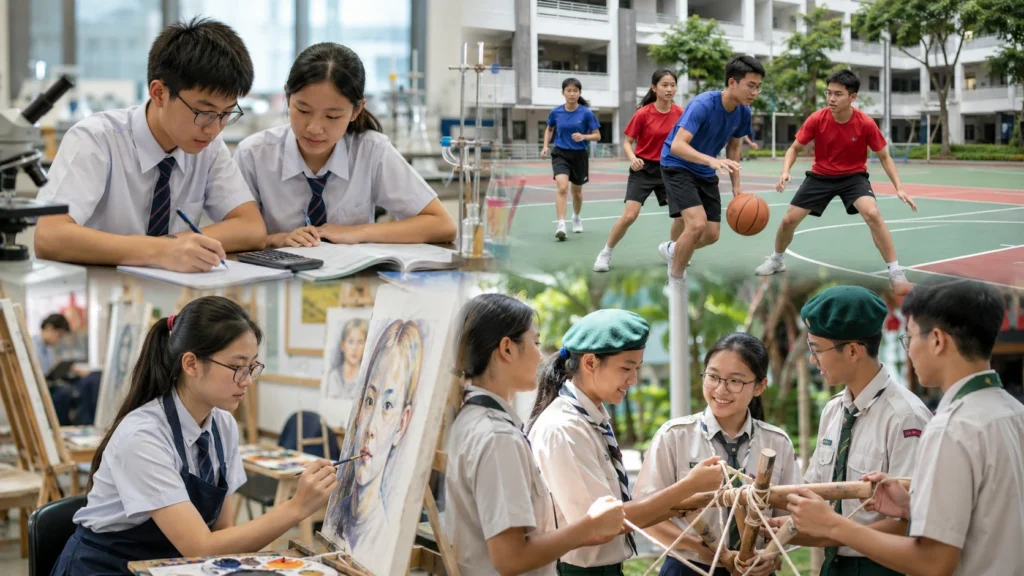
A school can have a strong reputation and still not be the best match for every student. When looking at the best secondary school for my child, start with what your child actually enjoys and does well in. An academically driven student may benefit from strong academic programmes, an IP pathway and deeper subject opportunities. A student who enjoys Science and Maths may be happier in a school with specialised STEM or applied learning programmes. For arts or sports-focused students, look closely at the opportunities available rather than judging a school mainly by academic reputation. And for a child who wants a more balanced school experience, CCA, school culture, student support and daily commute deserve attention too.
| Your Priority | What to Look For |
| Academics | Academic programmes and pathway |
| STEM | Science, Maths and applied learning |
| Arts | Arts programmes and facilities |
| Sports | CCA and competitive opportunities |
| Languages | SAP and bilingual programmes |
| Balance | CCA, school culture and student support |
COP Can Narrow Your Choices — But It Shouldn’t Make the Decision
Your PSLE score gives you a starting point when checking secondary school options, while the AL score system is used for Secondary 1 posting. A school’s previous-year COP can then give you an idea of how competitive its intake was. But COP is not a permanent admission score. It can move from year to year as student choices and posting outcomes change.
Is a lower secondary school COP better?
Not necessarily. A lower COP can point to a more competitive intake, but it does not automatically make one school a better choice than another. Look at the school’s programmes, CCA options, environment and pathway as well. School affiliation can also affect the COP that applies to an eligible student, so parents should check the latest official posting information before making their six choices. The same approach applies when comparing PSLE cut-off points — use them as a reference, not the whole decision.

Before You Use Your Six School Choices
Once you have a shortlist, look at the six secondary school choices as a mix rather than six versions of the same option. Include schools that match your child’s PSLE profile, but leave room for realistic choices too. A school may look appealing on paper, yet its programmes or CCA options may not suit your child.
Check the daily travel time as well. A long commute can become tiring after a few months, especially with lessons and CCAs. Before submitting your school choice after PSLE, check the latest MOE information on COPs, programmes, admission requirements and the Secondary 1 Posting exercise. The S1 Posting details can change, so avoid relying on old screenshots or previous-year advice when making your final secondary school admission choices.
Singapore’s Current Secondary School Pathways in One Minute
Singapore’s secondary school system now uses Full Subject-Based Banding (Full SBB), with students posted to Posting Groups 1, 2 or 3 and able to take subjects at different levels based on their strengths and learning needs. The Integrated Programme (IP) is another pathway offered by selected schools, typically providing a six-year route without the usual Secondary 4 national examination. Specialised secondary schools offer more focused options for areas such as sports, the arts, mathematics, science or applied learning. For parents, the useful part is the added subject-level flexibility — your child’s school pathway does not have to mean taking every subject at the same level.
Questions Parents Usually Ask Before Shortlisting a School
What are the good secondary schools in Singapore?
Good options include schools with strong academic programmes, IP, SAP, STEM, arts or sports pathways. The better question is which school suits your child’s interests, PSLE profile and preferred learning environment.
Which secondary school is best for a high PSLE score?
A high PSLE score can give your child access to more school choices, including highly competitive options. But academic fit, programmes, CCA and school culture still matter.
Does a lower COP mean a better school?
No. A lower COP generally shows that a school had a more competitive intake. It should not be treated as a direct measure of school quality.
What should I look at besides COP?
Check the school’s programmes, CCA choices, culture, location, support and available pathways. These can have a bigger impact on your child’s daily experience.
How many secondary schools can I select after PSLE?
Students can list six school choices during the Secondary 1 Posting Exercise.
Are neighbourhood secondary schools a good option?
Yes. Neighbourhood secondary schools can offer strong programmes, CCAs and supportive school communities. The label itself does not tell you whether a school is a good fit.
A Simple Final Shortlist Test
Before keeping a school on your shortlist, ask five quick questions:
- Does the school suit my child academically?
- Does it offer programmes my child actually wants to explore?
- Are the CCA options relevant to their interests?
- Is the daily commute practical?
- Would my child feel comfortable in the school environment?
If most answers are yes, the school deserves a place on your shortlist. A good secondary school is not simply the one with the lowest COP or biggest reputation. It is one where your child can learn well, take part in school life and feel comfortable growing over the next few years.
Final Thoughts on Good Secondary Schools in Singapore
Good secondary schools in Singapore are not defined by COP alone. A school may be highly competitive, but that does not automatically make it the right choice for your child. Look at the PSLE score, preferred subjects, school programmes, CCA options, pathway and daily commute together. And give your child some say too — their interests and comfort can shape the school experience just as much as academic results. A sensible shortlist should include schools that feel suitable, realistic and worth exploring before the final Secondary 1 choices are submitted.